

Do as I say now, not as I did then
Many Democrats, and much of the mainstream media, are claiming that President Trump violated the Constitution by using military force in Iran. What a difference a few years makes.

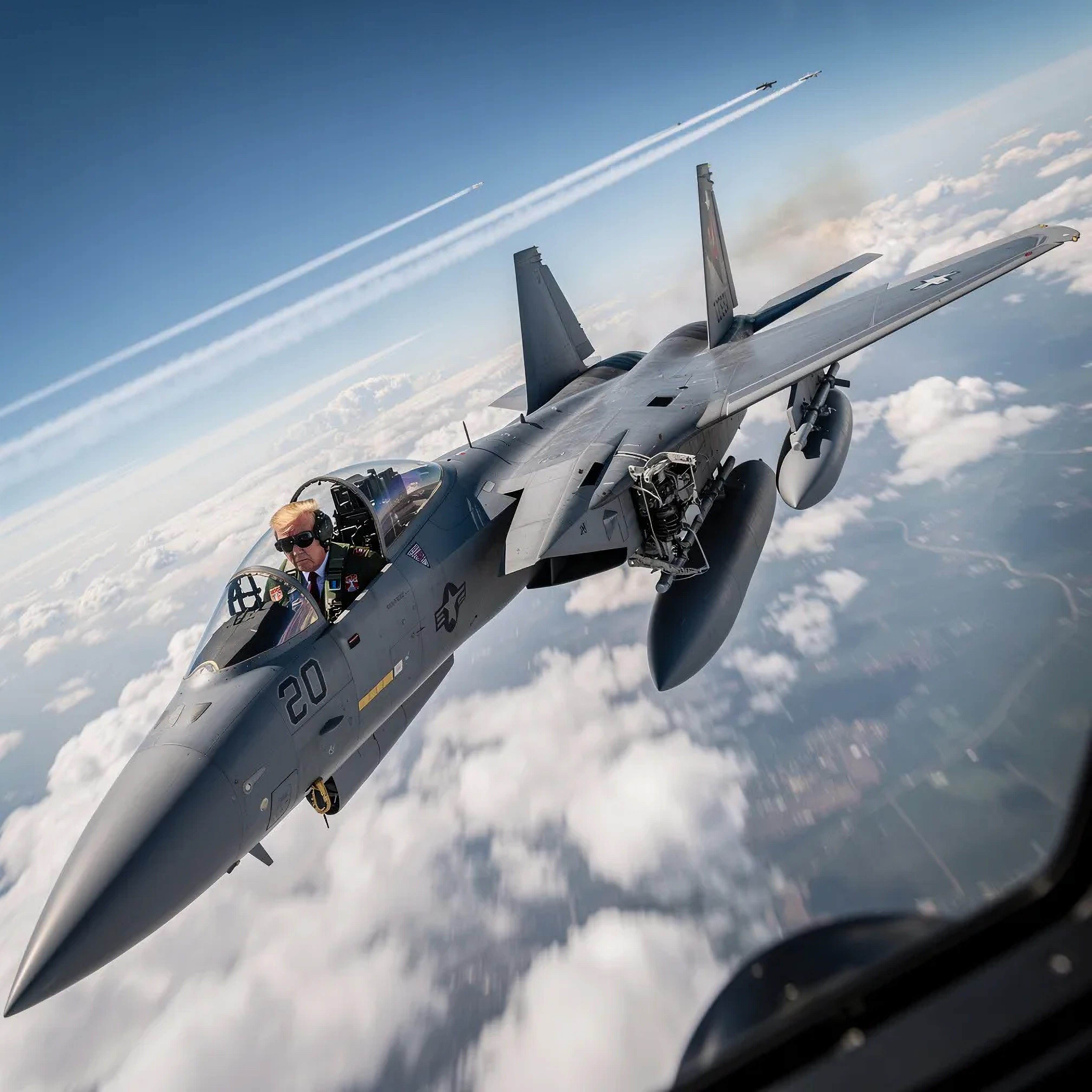
It’s been nearly a year since I last posted, but the hypocrisy surrounding claims that President Trump violated the War Powers Act, and that he has engaged in a unconstitutional war by attacking Iran, needs some context.
It’s one thing to be opposed to using military force against Iran—even some prominent Republicans and conservatives are opposed—but it’s disingenuous for many prominent leaders on the left, and some on the right, to call the attack on Iran unconstitutional. Some have even gone as far as describing it as yet another example of “fascism” and a further erosion of democracy.
Not surprisingly, Americans are divided about the Iran conflict, mostly along partisan lines. According to every major poll I have seen, a large majority of those identifying as Republicans support the President’s decision to attack Iran, while an equally large majority of Democrats oppose it.
But even within the hyper-partisan world of Congress, there are exceptions. For example, Representative Thomas Massie and US Senator Rand Paul, both Republicans from Kentucky and isolationists, have been vocal in their opposition to military intervention in Iran.
Massie—who is facing a Trump-backed opponent in a bitter Republican primary—has said military intervention in Iran “is not ‘America First.’” Paul, who often feuds with the President, was the only Republican to vote with the Democrats on a Joint Resolution of Congress calling for “the removal of United States Armed Forces from hostilities within or against the Islamic Republic of Iran that have not been authorized by Congress.” Paul chided his fellow Senate Republicans, saying they are “resigned to their own irrelevance” and “will gladly hand the president the power to initiate war in exchange for plausible deniability.”
A few prominent Democrats have also bucked their party line. Most notably, John Fetterman (D-PA). As reported by The Hill, Fetterman said he was “baffled” by some of his fellow senators not backing the recent U.S. military action against Iran. In a post on X, Fetterman wrote “Every member in the U.S. Senate agrees we cannot allow Iran to acquire a nuclear weapon…I’m baffled why so many are unwilling to support the only action to achieve that. Empty sloganeering vs. commitment to global security — which is it?” Fetterman was one of four Democrats to break with their party and vote with Republicans against the Joint Resolution.
Presidents have long chafed under the yoke of just about any limit on presidential power. From George Washington on—nearly every president, including Obama, Biden and Trump—have aggressively pushed the Constitutional boundaries of the presidency.
In 1794, Washington, for example, tamped down the Whiskey Rebellion by using federal troops to quell what he claimed was an insurrection. He was criticized for using the military to silence internal dissent and for taking a step towards a militarized, authoritarian state. Sound familiar? Lincoln questioned the constitutionality of his own suspension of habeas corpus and issuing the Emancipation Proclamation. More recently, Biden tried (unsuccessfully) to unilaterally forgive student debt and the Supreme Court just ruled Trump’s tariffs unconstitutional. In fact, few presidents have tried to systematically expand presidential power like Trump.
For now, I’ll put aside whether attacking Iran was a good, or bad, idea and instead focus on the claim that by attacking Iran, Trump has violated the constitutional separation of powers by usurping Congress’s power to declare war.
Presidents and the War Powers Act
Most Democrats in Congress, and some Republicans, have called Trump’s attack on Iran an unconstitutional abuse of presidential power. Only Congress can declare war, they argue. During debate on the joint resolution directing Trump to cease hostilities against Iran, former House Speaker Nancy Pelosi called the US Constitution a “casualty” of Trump’s “shortcut to war.” Later in the same debate, House Minority Leader Hakeem Jeffries described the President’s actions as “unconstitutional” and “unlawful,” and said “Article I of the Constitution explicitly provides Congress with the sole authority to declare war. There is nothing ambiguous about that.”
Or is there?
Presidents and Congress have sparred over the president’s power to use military force without prior congressional approval since the founding. But by 1973, Congress had had enough. After discovering that President Nixon had authorized a secret bombing campaign in Cambodia—a secret he also kept from Congress—and expanded the already unpopular Vietnam War, the House and the US Senate passed the War Powers Resolution, with bipartisan support, to limit the Commander-in-Chiefs ability to commit US forces abroad.
The Resolution, more commonly known as the The War Powers Act, was Congress’ attempt to put some explicit limits on the president’s power to unilaterally authorize military action, while also allowing a president to respond quickly and decisively when national security demanded.
It requires that the president “in every possible instance” consult with Congress before introducing US forces into hostilities (though it doesn’t require it, nor does it define “hostilities”). It requires the president to notify Congress within 48 hours of deploying military forces, and mandates that forces must be withdrawn within 60 days, unless Congress declares war, or extends the 60 day period. A thirty day withdrawal period can be added if the president certifies it is necessary for the safe removal of troops. That’s it. It is, in fact, tacit permission allowing a president to commit the US military for 60 days WITHOUT prior Congressional approval.
We can quibble about whether the President gave the proper prior consultation with Congress—though I think it’s a probability that some member of Congress, or staffer, would have run straight to the press. And we can also quibble about whether Trump gave the proper 48 hour notification AFTER hostilities had commenced—though his 8 minute video the evening of the attack seems to be plenty of notice. In any event, since then he has briefed Congress several times.
Many presidents have argued that the War Powers Act is itself unconstitutional or is situation dependent—and that the president has no obligation to get prior approval to commit US forces if they decide the national interest dictates. During the US Senate hearings on Libya and War Powers in June 2011, John Kerry, then Chair of the Senate Committee on Foreign Relations, noted that “for 40 years, Presidents have taken the view that this language does not include every single military operation. Presidents from both parties have undertaken military operations without express authorization from Congress.”
In an interview in 2007, then Presidential candidate Obama told the Boston Globe, ‘‘The President does not have power under the Constitution to unilaterally authorize a military attack in a situation that does not involve stopping an actual or imminent threat to the Nation.’’ But as President, as most presidents do, he embraced a very different view of presidential power.
Do as I say now, not as I did then
In March 2011, now President Obama authorized US military force, without prior Congressional approval, against Libya to oust its leader, Muammar Quadhafi—the autocratic dictator who had ruled Libya since taking power in a coup in 1969. Quadhafi was known to support and harbor terrorists, and in response to a popular uprising, his government had begun strafing crowds with gunfire and dropping bombs on those protesting his rule.
“Now, here is why this matters to us,” President Obama said in a press release defending his decision, “Left unchecked, we have every reason to believe that Qaddafi would commit atrocities against his people. Many thousands could die. A humanitarian crisis would ensue. The entire region could be destabilized, endangering many of our allies and partners. The calls of the Libyan people for help would go unanswered. The democratic values that we stand for would be overrun.” Gee, that also sounds familiar, doesn’t it?
But, you might ask, what about the War Powers Act and his pledge “not to unilaterally authorize a military attack?”
“The President,” his Justice Department argued, “had the constitutional authority to direct the use of military force in Libya because he could reasonably determine that such use of force was in the national interest. Prior congressional approval was not constitutionally required to use military force in the limited operations under consideration.“
Many Democrats stood with him, including Speaker Pelosi, who publicly praised President Obama “for his leadership and prudence,” and US Senator Chuck Schumer. “We have two goals,” Schumer said during a March 2011 press conference, “the humanitarian goal of preventing Muammar Qaddafi from rolling in and massacring innocent civilians,” and “to disrupt the command, control and supply” of Qaddafi’s forces. Not a word about Congress’ role in declaring war, only obedience to President Obama. By 2026, however, Schumer seems to have had the change of heart that often comes with a change of presidents. On the Senate floor, he described the Iran conflict as “a war of choice, not necessity,” and said that “Congress must act to rein in Donald Trump’s belligerence.”
I get it. In politics hypocrisy is almost a job requirement. And to Democrats, Trump is akin to the devil himself. But certainly, Iran is a greater threat than Libya ever was. And many of the reasons President Obama gave for using military force against Libya in 2011 apply to Iran now: atrocities against their people; destabilization of the region and endangering our allies and partners; and the overrun of democratic values that we stand for. Not to mention that Iran would otherwise be undeterred in securing a nuclear weapon. I don’t see how Iran in 2026 is less a threat to the national interest than Libya was in 2011.
And politicians aren’t the only hypocrites. In a 2011 editorial, the New York Times wrote “President Obama correctly agreed to deploy American forces” (in Libya), though not one word about questioning the constitutionality of his actions, or the War Powers Act. In 2026, however, the Times’ Editorial Board sings a different tune, criticizing Trump for not involving Congress, “to which the Constitution grants the sole power to declare war,” while admitting “The regime has wrought misery since its revolution 47 years ago — on its own people, on its neighbors and around the world…and killed hundreds of U.S. service members in the region, as well as bankrolled terrorism that has killed civilians in the Middle East and as far away as Argentina.”
Iran’s government presents a distinct threat because it combines this murderous ideology with nuclear ambitions. Iran has repeatedly defied international inspectors over the years. Since the June attack, the government has shown signs of restarting its pursuit of nuclear weapons technology. American presidents of both parties have rightly made a commitment to prevent Tehran from getting a bomb.
NY Times Editorial, Feb 28, 2026
Some might argue that since NATO was part of the Libya mission, and Libya was already in violation of a UN Security Council resolution, military intervention was justified. That might be true. But as the Washington Post reported, both Israel and Saudi Arabia—our strongest allies in the Middle East—urged the US to attack Iran. According to the Post, Saudi leaders “warned that Iran would come away stronger and more dangerous if the United States did not strike now, after amassing the largest military presence in the Middle East since the 2003 invasion of Iraq.” And with both China and Russia permanent members of the UN Security Council, with veto power over any resolution, good luck getting the UN to issue a resolution condemning Iranian aggression or for violently repressing its own people.
I hear people complain about existential threats to democracy all the time. Iran is an actual and literal existential threat. Certainly to Israel, and possibly to the rest of the Middle East. Iran’s brutal theocracy is committed to destroying Israel, and spreading its Shia version of Islam, not only throughout the Sunni Middle East, but the West as well. Through its proxies, like Hamas, the Houthis, and Hezbollah, it has been waging war, almost unfettered, on Israel and the West, including the US, for decades.
I could go on and on…and maybe I have. But the point I am laboring to make is this; if Trump is wrong to use military force against Iran in 2026 then Obama was equally—if not more—wrong to use military force against Libya in 2011. I understand why many Democrats think it’s politically expedient to claim Trump is, yet again, trampling on the Constitution—it’s their whole political playbook. And they are not always wrong. Trump, like many other Presidents, pushes the envelope of presidential power.
However, I believe it’s damaging the nation. Not because they don’t have the right to argue that attacking Iran is wrong—but because they are misleading Americans about WHY they believe it’s wrong. And in that, much of the mainstream media is also complicit—which might be more wrong.
As the saying goes, “you’re entitled to your own opinion, but not to your own facts.” The fact is that Trump’s attack on Iran is not unconstitutional—at least not yet. Whether it’s a bad idea or not, only time will tell.